
Capital · Transactions · Risk · Currency · Efficiency
Financial Intelligence for a More Efficient World
FinQuantify is a financial intelligence and transaction-structuring platform designed to make complex financial, capital and cross-border transactions more measurable, transparent and efficient.
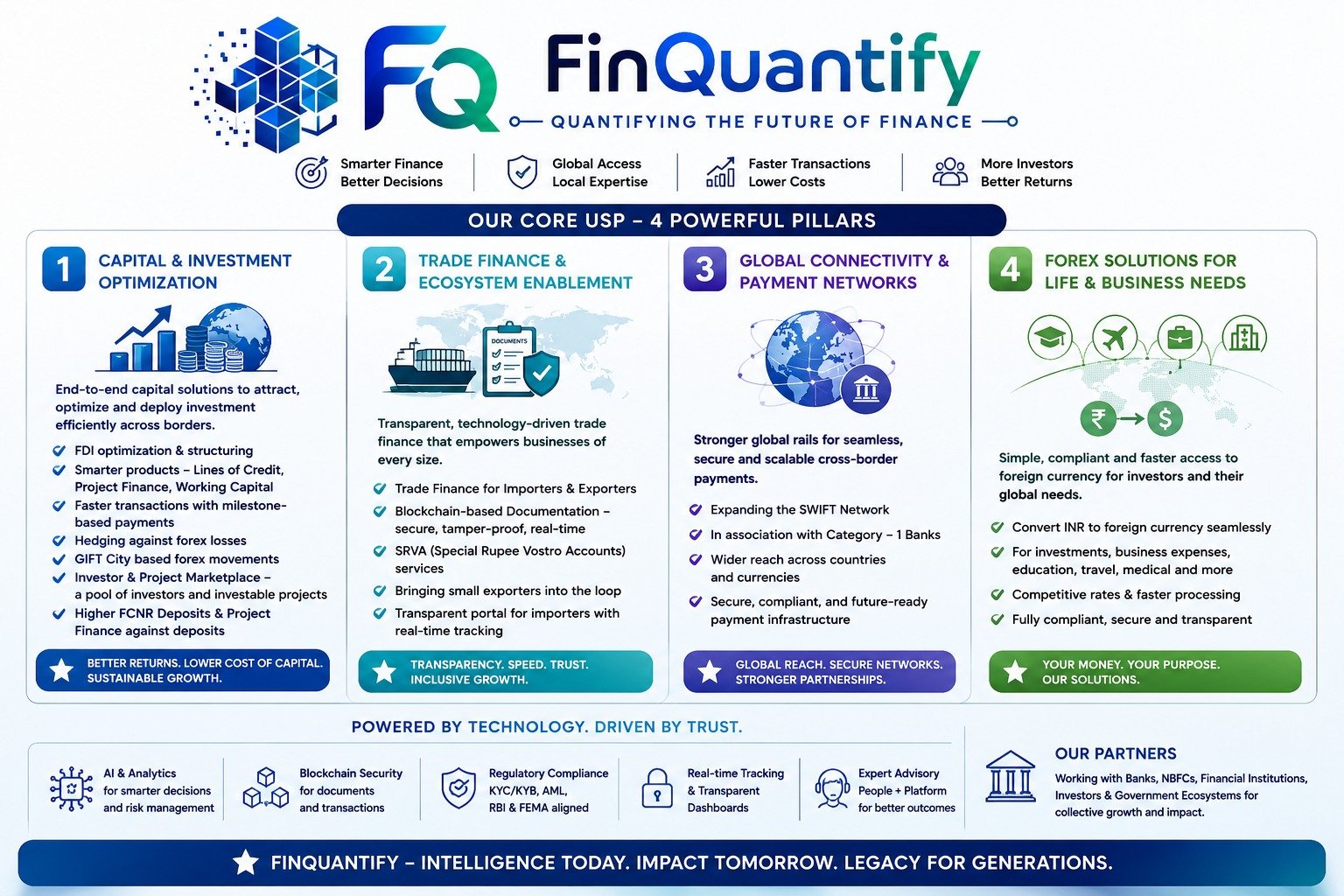
FinQuantify is being conceived as a financial intelligence and transaction-structuring platform designed to make complex financial, capital and cross-border transactions more measurable, transparent and efficient. Its purpose is not simply to move money, but to improve the intelligence with which capital is structured, verified, priced, protected and deployed.
Modern projects often do not fail because the underlying business is weak. They fail because financing is fragmented, counterparties are difficult to verify, risks are poorly quantified, foreign exchange is inefficiently managed, documentation is incomplete, or capital cannot move through the right regulated channels at the right time.
FinQuantify seeks to address this fragmentation by creating an orchestration layer that connects financial intelligence, transaction data, risk controls, capital structures and regulated financial-service providers.
An Intelligence Layer — Not a Conventional Bank
The platform is intended to work with regulated banks, payment service providers, financial institutions, insurers, investment partners and other authorised entities. Regulated institutions would continue to provide balance-sheet, payment, custody, settlement and other regulated functions where required, while FinQuantify focuses on technology, analytics, orchestration, verification and transaction intelligence.
The FinQuantify Principle
Break the financial problem into measurable components. Quantify each component. Optimise the structure. Verify the participants. Control the risks. Execute through the appropriate regulated channels.
What FinQuantify Seeks to Improve
Capital
Project finance, structured finance, FDI and capital deployment evaluated through a common analytical framework.
Transactions
Complex transactions broken into identifiable stages, counterparties, documents, risks, costs and settlement requirements.
Verification
KYC, KYB, AML, counterparty verification and transaction-risk controls incorporated into the workflow.
Currency
FX exposure, conversion costs, hedging requirements and settlement timing evaluated before execution.
Efficiency
Capital efficiency, transaction costs, timing, liquidity and risk-adjusted outcomes compared across alternative structures.
FinQuantify is intended to sit at the intersection of finance, technology, risk, trade and strategic decision-making — helping businesses and institutions understand not only whether a transaction can be executed, but whether it is structured intelligently.
The Financial Intelligence Architecture
From financial complexity to measurable intelligence, the platform concept follows one continuous loop:
Understand → Decompose → Quantify → Structure → Verify → Execute → Measure
Every transaction begins with a commercial objective — acquiring an asset, financing a project, importing equipment, raising capital, investing across borders, settling a trade or managing a financial risk. FinQuantify translates that objective into a structured financial problem: decomposed into capital requirements, parties, jurisdictions, documents, cash flows, currencies and risk exposures; quantified into measurable variables; compared across alternative structures; verified through KYC/KYB and AML checks; executed through appropriate regulated channels; and finally measured — comparing expected versus actual cost, timing, FX impact and outcomes to improve future decisions.
The FinQuantify Quantum
The term “quantum” represents the platform’s conceptual approach: a complex financial problem can be divided into smaller, measurable units, each of which can be analysed and optimised before being recombined into an efficient transaction structure. The ambition is to move financial decision-making from intuition alone toward data-supported, risk-aware and measurable intelligence.
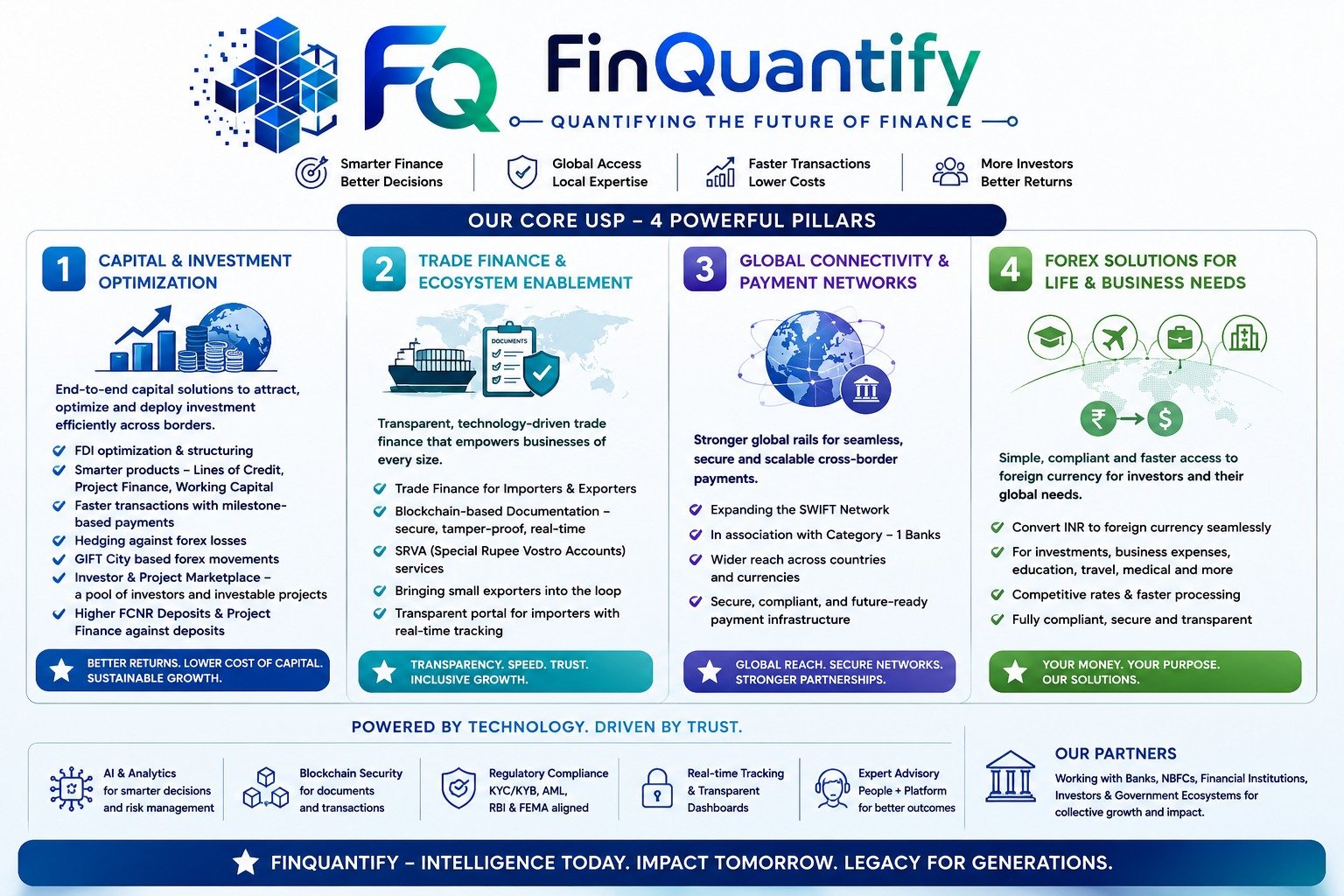
Core Solutions
01 — FDI & Capital Structuring
Analytical structuring of cross-border investments — capital requirements, investor and recipient structures, jurisdictions, documentation and execution pathways.
02 — Project & Infrastructure Finance
Sources and uses of funds, project cash flows, debt-equity structures, repayment capacity, security requirements and risk factors.
03 — Trade Finance & Cross-Border Transactions
Transaction intelligence for import-export flows — contracts, shipment documentation, payment stages and settlement.
04 — KYC, KYB, AML & Counterparty Intelligence
Structured workflows for identity and business verification, beneficial ownership and sanctions checks.
05 — Fraud & Transaction Risk Management
Transaction patterns, documentary signals and workflow controls that flag inconsistencies before execution.
06 — FX Intelligence & Hedging
Quantifying the effect of exchange rates, conversion spreads, timing and hedging strategies on transaction economics.
07 — Settlement & Payment Orchestration
Coordinating the workflow required to move a transaction through the right payment and settlement channels.
08 — Capital Efficiency
Comparing alternative uses of capital by financing cost, liquidity, timing and risk — not just the headline rate.
09 — Financial Verification & Transaction Intelligence
A structured information layer connecting documents, counterparties, assumptions and risk indicators into one system.
A Financial Operating Map
Commercial Objective
What is the business trying to achieve?
Capital Requirement
How much capital is required, when, and for what purpose?
Counterparties
Who are the participants and how are they verified?
Jurisdictions
Which countries, currencies and regulatory environments are involved?
Risk
What can go wrong and how can each exposure be measured or controlled?
Cost
What is the complete economic cost, including fees, FX and financing?
Execution
Which regulated institutions and channels are required?
Outcome
Did the structure achieve the intended commercial and financial objective?
Most financial systems optimise a product. FinQuantify seeks to optimise the transaction — bringing the relevant financial, commercial, risk and operational variables into one analytical framework, rather than leaving them fragmented across institutions and jurisdictions.
Trust, Security & Governance
A financial-intelligence platform cannot be built around convenience alone. Identity, data integrity, transaction traceability, privacy, access control and regulatory accountability are embedded into the architecture from the beginning.
Identity First
Verify the individual, business and beneficial ownership before high-risk financial actions.
Risk-Based Controls
Stronger review and escalation where transaction, jurisdiction or counterparty risk warrants it.
Document Integrity
Consistency between contracts, invoices, corporate records and payment instructions.
Traceability
Auditable transaction workflows so key actions and exceptions can be reconstructed.
Data Security
Sensitive financial and identity information protected through appropriate access controls.
Human Oversight
Appropriate review and escalation rather than relying exclusively on automated decisions.
Regulatory Alignment
Workflows designed to operate within applicable law and regulated-partner requirements.
Where a product or transaction involves regulated activities, FinQuantify is intended to partner with appropriately authorised institutions rather than presenting itself as a substitute for regulated banking, payment, custody, lending or investment services.
The Future of Financial Intelligence
The long-term opportunity is larger than payment processing. Financial transactions are systems involving capital, information, counterparties, contracts, risk, currency, regulation and time — and a platform capable of understanding these relationships can create value before, during and after the movement of money.
Potential intelligence layers: Capital Intelligence · Transaction Intelligence · Risk Intelligence · Compliance Intelligence · Currency Intelligence · Settlement Intelligence · Decision Intelligence.
Within Pandava Supereon, FinQuantify represents the philosophical strength of Foresight: understanding the financial system before acting within it. Its role is complementary to the Group’s other capabilities — helping connect technology, sustainability, infrastructure, entrepreneurship and institutional development with appropriate capital structures.
Capital should not merely move. It should move intelligently. Measure the problem. Structure the solution. Verify the participants. Control the risk. Execute with intelligence.